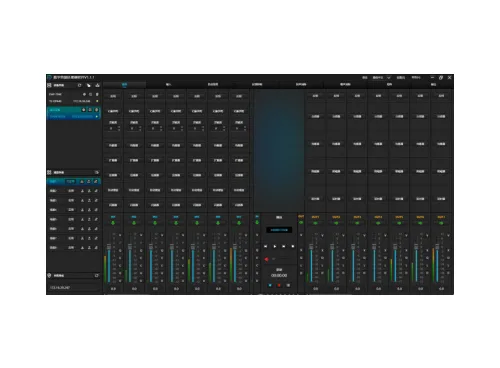
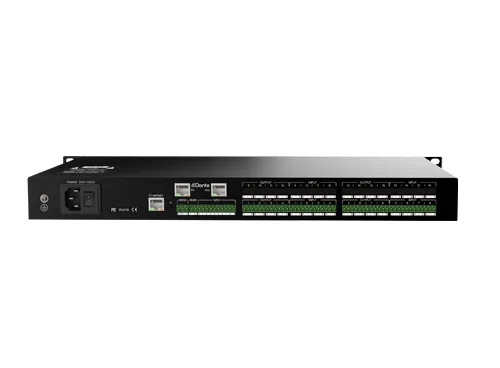
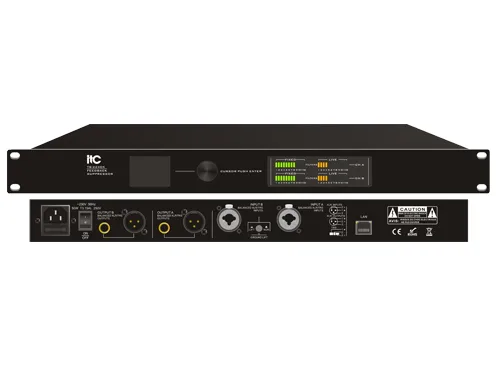
The digital audio processor project aims to develop an audio processor hardware and software platform that combines software and hardware technologies to provide comprehensive audio processing capabilities and flexibility. The digital audio processor hardware has the ability to integrate with external devices to achieve more comprehensive audio processing and functional expansion. The digital audio processor software is an innovative product developed on the basis of hardware devices, with the characteristics of precise processing, real-time response, and versatility. The software integrates: phantom power supply, ducker, expander, equalizer, compressor, automatic mixing, feedback suppression, delay, crossover, limiter and other functions.
Features
Supports software management of 4-in-4-out, 8-in-8-out, 12-in-12-out, and 16-in-16-out channel devices, with individual switch configuration for flexibility and convenience.
Allows storage of 8 preset modes for different usage scenarios, with quick switching between scene modes via software.
Supports 199 preset scenes, with parameters from preset scenes applicable to any stored scene.
Supports adding various types of demonstration devices, including DP, AI, and TS series devices.
Supports adjustable ducking function, automatically ducking the microphone when background music is played, with multiple parameter settings for flexible on-site application.
Supports adjustable extender function, reducing the gain of smaller signals and increasing the gain of larger signals, expanding the dynamic range of the audio signal to enhance dynamic response and realism.
Supports adjustable equalizer function, with each channel featuring a 12-band parametric or graphic equalizer, offering 10, 15, and 31-band graphic equalizers; supports adjusting the volume of different frequency ranges in the audio signal, correcting the timbre and spectral balance for better listening effects and audio performance.
Supports adjustable compressor function. By setting a threshold, the dynamic range of the audio signal can be controlled, keeping the audio volume stable within a certain range, avoiding excessive volume fluctuations, and preventing distortion when the audio signal reaches a certain volume threshold.
Supports adjustable automatic gain function. Automatically adjusts the gain (volume) of the audio signal to maintain a consistent output audio volume for audio inputs of different volumes.
Supports recording and playback automatic gain function, with on/off control, parameter reset, start level, and maximum gain.
Supports adjustable automatic mixing function, including gain-sharing mixing and threshold automatic mixing. When multiple signal sources are present simultaneously, the gain-sharing mixing system automatically detects the volume level of each signal source and automatically adjusts the gain (volume) of the signal sources. Threshold automatic mixing supports setting a threshold. When the intensity of the audio signal exceeds or reaches the threshold, the mixing system automatically adjusts the volume of the signal; when the intensity of the audio signal is below the threshold, the volume of the signal is automatically reduced or muted.
Supports adjustable feedback suppression function. This can eliminate or reduce potential noise or whistling problems in the audio system to ensure clear and stable audio output.
Supports adjustable echo cancellation, eliminating echoes caused by sound reflections in rooms, spaces, or transmission paths, preventing noisy and chaotic auditory experiences.
Supports AI echo cancellation, which eliminates acoustic echoes generated at the microphone end from the speaker signal in real time. It suppresses linear and nonlinear echoes while removing background noise in complex two-way and reverberation scenarios, maximizing the preservation of effective near-end speech, improving call clarity and natural interaction, and is compatible with full-duplex conferencing systems and remote communication terminals.
Supports adjustable matrix functionality, allowing users to flexibly route, mix, and process multiple audio input and output signals to meet the needs of different application scenarios.
Supports adjustable delay functionality, allowing users to adjust parameters to introduce a certain amount of time delay to adjust the relative time of audio signals, achieving clarity, picture, and audio consistency.
Supports adjustable crossover functionality, allowing users to perform frequency segmentation and partitioning of audio signals to achieve independent control and processing of different frequency ranges. Crossovers improve the flexibility and effectiveness of audio processing, providing users with a better audio experience.
Supports adjustable limiter function. By setting a threshold, the amplitude of the audio signal can be controlled to prevent audio distortion and damage to audio equipment. This ensures that the audio output is within an appropriate range, providing better audio quality and protecting audio equipment.
Product datasheets are available for download to authorised users only. To obtain a partner account — which grants you access to download any resource on this website — please get in touch through our contact form.