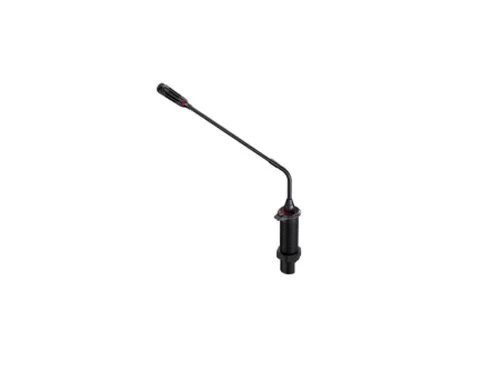
Conference Systems · Digital Conference
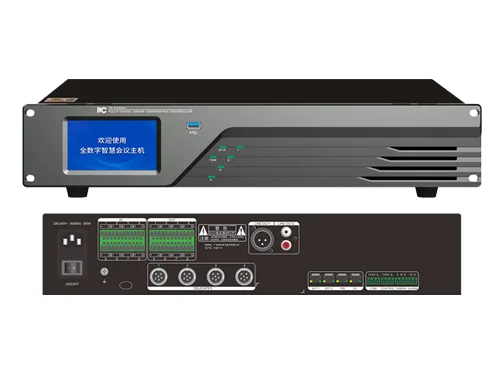
This full-digital conference system is built on a gigabit network audio transmission architecture, supporting multi-channel concurrent processing and enabling 128 microphones to be used simultaneously and speak stably. The system highly integrates audio processing and conference discussion control functions, possessing professional-grade audio processing capabilities, with end-to-end latency as low as 2–3 milliseconds from conference unit sound pickup to audio processing output. Simultaneously, the system innovatively integrates practical functions such as multi-room management and identity recognition, comprehensively empowering a high-quality, high-efficiency conference sound reinforcement experience.
Features
- Built on a gigabit network audio transmission architecture, all core components use domestically produced chips, and can connect to digital wired microphones, digital wireless microphones, and analog microphones; it supports multi-channel concurrent processing, enabling 128 microphones to be turned on and speak stably at the same time.
- With an ultra-large system capacity, it supports simultaneous access and management of 65,535 wired conference units and 300 wireless conference units; it also supports simultaneous participation of 65,535 conference units in the meeting agenda (check-in, voting, services, etc.) and speech control.
- It features highly integrated DSP audio processing capabilities, including ducking, automatic gain control, equalizer, compressor, expander, automatic mixing, feedback suppression, echo cancellation, ambient noise reduction, matrix routing, EQ adjustment (supporting 8-band, 10-band, 15-band, and 31-band EQ adjustment), volume dB adjustment, and delay adjustment.
- Equipped with professional-grade audio processing capabilities, it achieves a low latency of 2-3 milliseconds across the entire audio processing chain, from conference unit pickup through ducking, automatic gain control, equalizer, compressor, expander, automatic mixing, feedback suppression, matrix routing, EQ adjustment (supporting 8-band, 10-band, 15-band, and 31-band EQ adjustment), volume dB adjustment, to audio processing output.
- This industry-innovative system adopts a "one-machine-multiple-zone" and "multi-machine interconnection" approach. A single host can be divided into eight independent conference zones, each with its own dedicated microphone and audio channel. Simultaneously, conference functions operate independently without interference, including check-in, voting, and priority settings, ensuring spatial isolation and independent operation. Furthermore, the system supports flexible audio interaction modes, enabling cross-zone two-way communication to meet the needs of group discussions and centralized training sessions. Multiple hosts can be interconnected via a network for unified management, significantly improving resource utilization and making system deployment and expansion more flexible and efficient.
- Multi-mode meeting management and high-concurrency processing: The system supports the creation of 8 independent meeting rooms and can flexibly switch between 7 speaking modes for each meeting room, including first-in-first-out, normal mode, request mode, voice control mode, last-in-first-out, free discussion and queuing mode, to adapt to different meeting formats.
- Ultra-large data processing capability: The system supports simultaneous speaking from 128 conference units and has a function to customize the number of speakers per conference unit. The number of speakers per wired conference unit can be set to any number between 1 and 128; the number of speakers per wireless conference unit can be set to any number between 1 and 8.
- It supports recording audio from individual microphones when used with recording software. It can record the audio of 128 conference sessions separately, and after recording, the audio of each microphone will be generated into a separate WAV file and saved locally.
- It features USB flash drive recording and playback capabilities, supporting individual or combined audio recording of any of the eight channels (IN1~IN8), and allowing users to select individual recording of wired/wireless microphones or perform audio mixing. It also supports audio playback via USB, with selectable individual or combined playback of the ten output channels (LINE OUT 1, LINE OUT 2, OUT 1~OUT 8), meeting diverse needs for meeting recording and multimedia applications.
- All 8 input channels support individual configuration to enable or disable 48V phantom power supply, and each input channel supports sensitivity adjustment.
- It features a 9-input, 10-output audio matrix routing function, and the audio output channels can be configured as wired role separation output mode, wireless role separation output mode, simultaneous transmission output mode, and phase control mode; each audio output channel can independently adjust audio parameters, including volume adjustment, equalizer adjustment, delay adjustment, limiter adjustment, and phase inversion adjustment functions.
- The role separation output mode allows wired or wireless units to output independently based on their ID numbers. By expanding the wired units, it supports 128 independent audio outputs, and the wireless units support 8 independent audio outputs. It also supports independent recording of each unit through recording software or docking with a speech-to-text device to achieve role separation.
- It supports 8-channel simultaneous output mode, with simultaneous audio output independently based on channel number, which can be used by recording or monitoring devices. Furthermore, the number of output channels can be cascaded with external audio processors.
- When the output mode is phase control mode, the matrix router can customize any route for 12 input channels and output channels (LINE OUT1, LINE OUT2, USB recording, wired download, wireless download, OUT1~OUT8). Each channel can be customized as mixing group 1 and mixing group 2, and the functions of feedback suppression, echo cancellation and environmental noise reduction can be customized and enabled.
- The main unit is compatible with simultaneous connection of digital wired microphones, digital wireless microphones, and analog microphones, and all three can be used in parallel. It adopts cross-domain audio synchronization technology, provides input configuration functions, supports selection of any input channel, can switch between microphone input and line input, and adjust phase inversion, volume, ducking, automatic gain, equalizer, compressor, and expander. In microphone input mode, it can also control the phantom power switch, configure camera tracking, voice tracking thresholds, and switch functions.
- It features automatic mixing capabilities, including gain-shared automatic mixing and gated automatic mixing; it has two mixing group settings, with mixing modes including gain-shared automatic mixing and gated automatic mixing. Gain-shared automatic mixing allows setting output gain, gain step size, slope, response time, and mute on/off audio parameters, including input source gain, mute, priority, and automatic mixing settings; gated automatic mixing allows setting output gain and mute on/off audio parameters, including input source gain, mute, sensitivity, and automatic mixing settings.
- It supports adjustable output channel equalizers, with each channel featuring an 8-band parametric equalizer or graphic equalizer, offering 10, 15, and 31-band graphic equalizers. The parametric equalizer supports selection of overhead, undermount, and parametric filter types, as well as setting parameters such as frequency, gain, and Q/OCT; the graphic equalizer supports three modes: narrowband, normal, and wideband.
- The system has functions for meeting check-in, voting, election, rating, satisfaction, and customization.
Request a Project Consultation